Why We Embroider (and When DTF Wins)
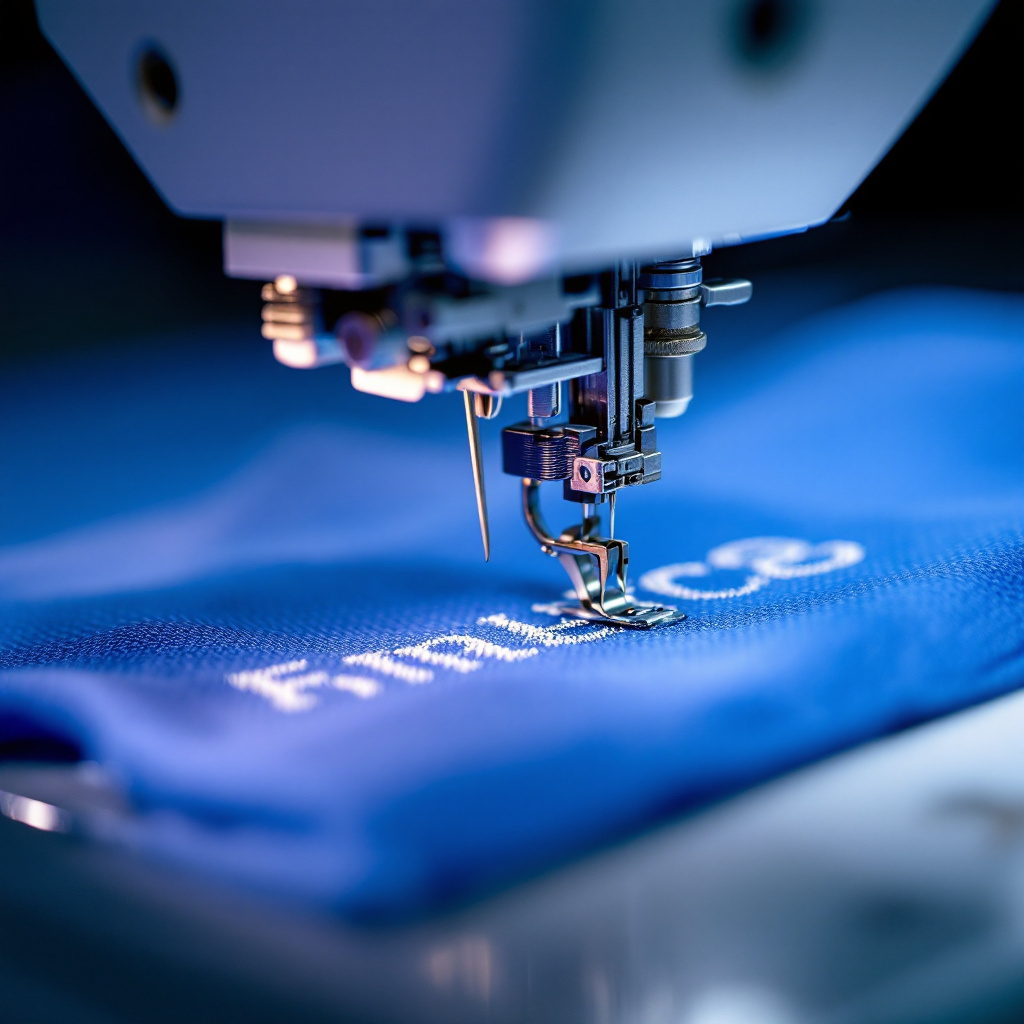
Most mornings I walk the production floor, and I always end up at the embroidery line. A needle is carrying thread down through the piqué and back up until the mark and the fabric are one object. Nothing gets applied to the surface of the polo. That is the closest thing this company has to a thesis, and it's what I mean when I say a logo on a blank is a label, not a brand.
Embroidery is the default on most of what we make. I want to lay out why, and then go through the four cases where I'll tell you to print instead.
A print is a layer on the fabric.
Every printed garment is two objects, a textile and something bonded to it. The fabric stretches more than the print does, and it breathes where the print doesn't. Every wash tests the bond, and when the bond loses, the print cracks. Good printing pushes that failure years out, but it can't remove it.
An embroidered mark has no bond to fail. The thread passes through the fabric and locks on the reverse, which leaves no edge to lift and no surface to crack. Wash it for years and the mark is as present as the collar, because it's held the same way the collar is. Stitched in like that, a left-chest mark will outlive the garment it's on.
Why an embroidered mark looks expensive
Start with the hand. Run a thumb across a printed chest and you feel a smooth plateau on soft cotton. Run it across raised satin stitch and you feel texture, the way you'd feel a collar seam or a button. It reads as part of how the garment was built, and I think that's what people are noticing when they call a piece expensive and can't say why.
Thread does tone-on-tone like nothing else. With navy on navy or sage on sage, the mark shows when light rakes across the fleece and goes quiet across a dinner table. Meridian Capital's polos carry a navy micro-check in navy thread, and their partners request the piece. For gifts and executive kits, that restraint is the reason to choose thread.
Scale stays honest. Embroidery has a natural size, up to about 4 in wide on a chest or a crest on a cap. It can't be a billboard, and I count that limit in its favor.
The limits of embroidery
Embroidery isn't always the answer, and it's better you hear that here than in a sample review.
- Type has a floor. Thread is thicker than ink, and below 5 mm letters close up and the counter of an "e" fills in. A tagline that sits comfortably in a print gets enlarged for thread or dropped from the embroidered version.
- Gradients belong to DTF. A needle places one solid color at a time. We can blend two threads across a fill for a subtle shift, but a purple-to-pink fade is a print job.
- Heavy fills stiffen the garment. A left-chest mark runs 5,000 to 12,000 stitches, and a dense fill across a whole chest runs many times that. We price embroidery in one business day, and the cost I'd watch for shows up in the garment, where fleece goes stiff and piqué puckers under a heavy fill. The Studio designs to a stitch budget to avoid that.
Our decoration methods guide sets these limits beside the limits of print.
Four cases where DTF print wins
Print is our second method, and it exists because the first has limits. Direct-to-film printing puts full-color artwork onto a film and heat-bonds it to the garment, and there are four cases where it wins outright.
- Big graphics. A full-back pattern or an edge-to-edge chest piece is print territory. Back prints run up to about 12 in wide. Thread can't cover that area without turning a tee into armor.
- Gradients and fine detail. DTF holds smooth color transitions and hairline strokes, with no color-count limit.
- Photographic artwork. A photo or an illustration with shading is print. So is anything past 12 colors.
- Weekly wear. A good DTF print is rated for 50-plus washes without cracking, with a flush finish. On a 220 GSM tee washed twice a month, that's more than two years.
All eight products take either method, from the hoodie to the polo, and we choose piece by piece instead of once for the whole order. Print also covers DTG, where the ink goes straight into the fabric, and vinyl heat transfer, which suits names and numbers. We offer screen printing too, and if you ask we'll tell you which garments suit it.
How the Studio picks a method for each piece
When you brief the Design Studio, it looks at each mark on each product and asks how big the mark is and what fabric is underneath. A small mark on piqué or twill leans thread, and a large mark on fleece or jersey leans print. Color settles the rest, since a gradient anywhere is print and a tonal crest anywhere is thread. A designer on our team checks the answer on every order before anything is stitched or pressed.
Poly9 is the clean example. Their brand is a purple-to-pink gradient, which no needle can stitch. For their ten-person booth team, the Studio split the brand across two methods. The gradient went DTF-printed across the chest of the booth tees, and the same geometry went onto the polos as a tonal embroidered mark.
We'll use both methods, and we'll tell you which one is on every piece. How a mark gets built is on our embroidery page and its DTF counterpart.